Why governance makes all the difference in strong IT partnerships
Technology is important. You won't get far without a stable environment, good security and smart design. But if an IT collaboration is difficult, the cause is not always in the technology itself.
Often things go wrong in the agreements around it. Who makes which decision? Where does a subject belong? When do you scale up? And are the right people at the table to make choices and make decisions? It is precisely these questions that determine whether cooperation costs energy or gives room to move forward.
That is what governance is all about: organizing roles, responsibilities and decision-making in such a way that cooperation becomes easier.
"The technology has to be good, that's beyond dispute. But in the end, the collaboration determines whether you are successful. Good governance ensures peace of mind, faster decision-making and more room for improvement and innovation."
Governance is more than rights and rules
In IT, governance is often linked to policy, access rights, security and compliance. That is an important part of the story. But in a collaboration around managed services, governance is also about the way you work together: what roles there are, how consultation moments are set up and how decisions are made at the right level.
Kars Brouwer has been working in service and delivery management and transition processes for over twenty-five years. From data centers to cloud and application management. He sees the same pattern in all these environments: if the governance is clear, peace arises. Not because everything is fixed, but because everyone knows what the intention is.
The Wortell Partnership Governance Model translates this into practice. It makes it clear which conversations are needed, who should be involved and how topics move from operational to tactical or strategic level if necessary.
No consultation for the sake of consultation
Governance sometimes has a heavy image. As if it is mainly about extra meetings, formats and complicated structures. While good governance does just the opposite: it prevents noise.
A well-designed consultation model ensures that topics are discussed where they belong. Operational bottlenecks do not linger indefinitely. Strategic choices do not disappear between tickets and separate coordinations. And points for improvement are given an owner, a follow-up and a decision.
The mirror principle helps with this: for every role on the one hand, there is a logical discussion partner on the other. Think of service delivery and service management, account management and supplier management, architecture and IT strategy. In this way, consultations do not become a mandatory issue from one party, but joint moments in which you give direction, make choices and monitor progress. This requires people at the table who know what is going on, are well prepared and can make decisions when necessary.
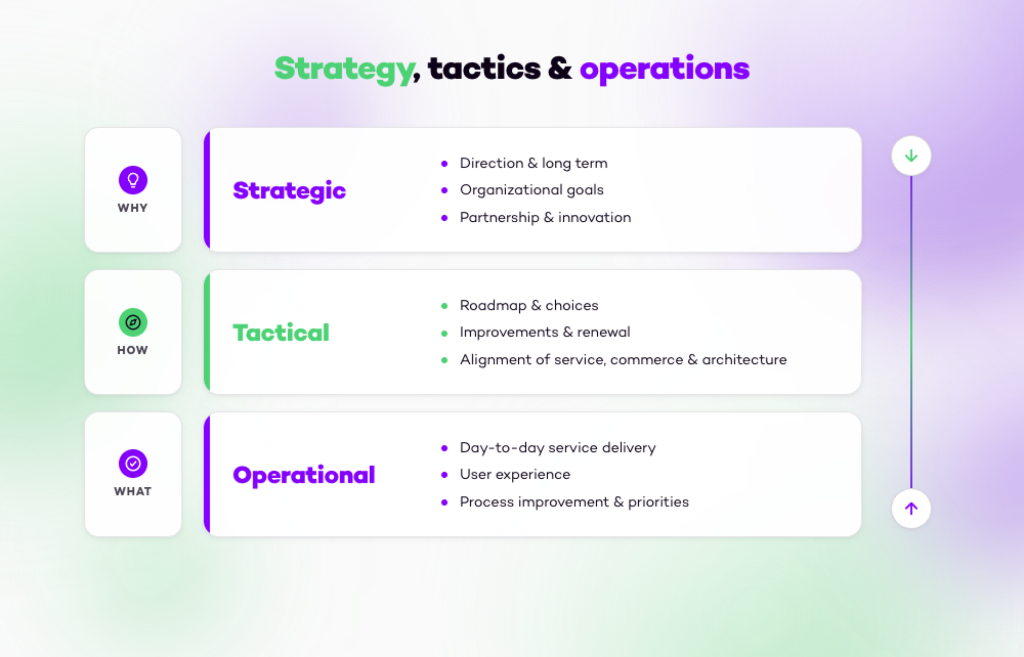
Three levels that remain connected
The model distinguishes between strategic, tactical and operational levels. Not as separate worlds, but as a whole. What is discussed at one level is followed up on the other.
- Strategic: direction and partnership
At the strategic level, it is about the longer term. Where does the organization want to go? How does IT move along with this? And how do you use the partnership to not only keep the operation running, but also to look ahead?
At a healthcare organization, such a conversation led to a broader view than just IT. Together we discussed not only the IT strategy, but also the organizational goals behind it. This resulted in various Business & AI use cases to automate non-care tasks, such as automatic voice reports, summaries of files, smarter schedules and a writing style assistant for chats and documents. The result: time savings, less pressure on the back office and more space for care at the bedside.
- Tactical: from direction to roadmap
At the tactical level, direction is translated into choices, planning and improvement. This is where performance, roadmap, architecture and commercial agreements come together. It is precisely this cohesion that makes it possible to manage better and to look at choices not only from the point of view of technology, planning or budget.
At an international organization, projects, architectural choices and market developments were intertwined. As a result, there was a lack of overview. Together, we translated these topics into one clear roadmap. Goals, strategy and external developments were translated into concrete actions. This gave more control, reduced risks and resulted in more predictable costs.
- Operational: peace of mind in daily practice
At the operational level, it's all about today's services. Here you can immediately see whether agreements work. Are priorities clear? Are recurring issues structurally addressed? And is there room to improve instead of just reacting?
In collaborations in which the Operational Consultation has a fixed agenda and clear follow-up, you can quickly see a difference. Together you discuss not only the outstanding actions, but also recurring patterns: where does noise arise, which priorities are unclear and which agreements need to be sharpened? This makes the conversation more practical and prevents the same topics from coming back over and over again.
The result: less ad hoc coordination, more clarity about priorities and more time for engineers to work on solutions that make a lasting difference.
Governance must move with it
There is no standard model that fits exactly everywhere. In the start-up phase of a collaboration, more coordination is often needed. Roles must find their place, agreements must be tightened up and the right rhythms must be created. As soon as the service becomes more stable, the frequency can be reduced or consultations can be merged.
If the collaboration grows into a strategic partnership, the attention shifts. Less focus on the how, more room for joint innovation. Governance therefore only works if it moves with the phase of the collaboration. Otherwise, consultation quickly becomes something you do because it is set up that way, rather than because it helps. And as soon as a meeting becomes a goal in itself, it works against you rather than for you.
Escalation is also part of professional collaboration
Escalating often sounds negative, but it doesn't have to be. Sometimes escalation is necessary to make a decision, to determine a priority or to discuss a topic at the right level. It is precisely by not escalating that issues can be left unresolved and frustration increases.
It helps to agree in advance when something is an escalation, who should be involved and what the goal is. Then the conversation remains substantive and focused on progress. Not on being right, but on coming to a decision faster.
In practice, an escalation can, for example, lead to a Service Improvement Plan. In it, you determine together what needs to change to prevent recurrence. This can involve sharper priorities, clear ownership of recurring issues or better alignment between operational and tactical consultations. In this way, an escalation does not become an end point, but a way to accelerate decisions and make cooperation stronger.
What it yields
The yield is mainly seen in the daily cooperation. Teams know better where they stand. Priorities are clearer, recurring issues are followed up faster and less loose coordination is needed to move forward. At the same time, there is more cohesion between operation, roadmap, architecture and organizational goals, making conversations more concrete and decisions better substantiated.
The result is a collaboration that is less dependent on individual people and relies more on clear agreements. Decisions are made faster, improvements are not left undone and there is room to look ahead together.
The structure behind cooperation that seems to go smoothly
If governance is set up properly, cooperation feels logical. People know how to find each other, topics end up at the right level and everyone knows what it takes to move forward. That seems to come naturally, but that is precisely where the value lies: clear structure without unnecessary weight.
The Wortell Partnership Governance Model helps to create that structure. With attention to forms of consultation, roles, agendas and escalation paths. Not as a blueprint that has to be the same everywhere, but as a practical model that moves with the collaboration.
Want to know more?
Curious about how your governance is set up and where improvement is possible? We like to think along. Contact us for the Partnership Governance Model, a quick scan of your current consultation structure or a conversation with Kars Brouwer.